
Many business owners hear about invoice factoring and assume it works like a loan — apply today and receive funding within a few days. In reality, invoice factoring is a structured financial facility, not a once-off loan.
A funder advances money against your invoices, which means a detailed approval and onboarding process must take place first. This means you cannot usually access a factoring facility immediately. The process takes time, but once it is approved and set up, it becomes a revolving source of working capital for your business.
This article explains the typical steps involved so you know exactly what to expect if you decide to apply.
Why the approval process takes time
Invoice factoring works very differently from traditional funding.
Instead of lending money based on your affordability or profit history, the funder is financing work your business has already completed and invoiced. The facility is structured around:
- Your business
- Your clients (your debtors)
- Your invoices
- Your trading history
For this reason, the funder must carefully assess both your company and the companies that owe you money before approving the facility.
Understanding How Invoice Factoring Works
Before starting the process, it is important that you understand how invoice factoring works and what the requirements are.
This includes understanding:
- How your invoices will be funded
- How your clients will pay funded invoices
- The role the funder plays in the process
- The cost of the facility
This step ensures that invoice factoring is the right solution for your business before you proceed with the application.
Document Request and Initial Assessment
Once you confirm that you would like to proceed, the funder will require supporting documentation.
This usually includes:
- Your company registration documents (CIPC)
- Latest financial statements
- Recent management accounts if financials are older than three months
- Your debtors book
- Business bank statements
- Trade history with clients that owe your business money
These documents help the funder understand:
- The stability of your business
- The strength of your debtor book
- How your clients typically pay their invoices

Review & Feedback
After you have submitted all the required documents, the funder will begin reviewing your application.
In most cases, you will receive feedback within two working days after the full document pack has been received.
At this stage, the funder may:
- Request additional information
- Provide feedback on the application
- Issue a proposal for a factoring facility

Due Diligence and Site Visit
Before final approval is granted, the funder will usually conduct a site visit.
This involves an in-person meeting where the funder reviews your business operations and verifies the information provided during the application.
The purpose of this step is to:
- Confirm how your business operates
- Verify the information submitted in your application
- Ensure that your debtor relationships are legitimate
This is a standard part of the due diligence process for invoice factoring facilities.
Accepting the terms of the facility
If your application is successful, you will receive a proposal outlining the terms of the factoring facility.
This typically includes:
- The size of the facility
- The advance percentage on invoices
- The factor rate
- Payment terms
- The collection method for invoices
At this stage, you will also decide how payments from your clients will be collected.
Contracts and Legal Agreements
Once the offer has been accepted, the facility agreements will be issued.
These contracts outline:
- The terms of the facility
- The responsibilities of both parties
- The process for funding invoices
The agreements must be signed before the facility can become active.
Banking Setup
To secure the facility, a controlled payment structure must be put in place.
This means that invoices funded through the facility must be paid into a specific bank account.
There are two possible options:
Option 1: Your clients pay the funder directly.
Option 2: A separate bank account is opened in your company name which the funder controls.
If a new bank account needs to be opened, this can add one to two weeks to the onboarding process while the account is created and confirmed by the bank.
Onboarding and System Setup
After the contracts have been signed, you will be introduced to your account executive.
An onboarding session will then be scheduled to show you how the funder’s system works.
During this session, you will learn:
- How to submit invoices for funding
- How the online portal works
- How payments are processed
- How to track funded invoices
Access Your Working Capital Facility
Once the onboarding process is complete, your factoring facility becomes active.
From this point, you can start submitting invoices for funding.
Funds are typically released within a few days after submitting approved invoices, and the facility continues to revolve as new invoices are issued.
This allows your business to convert invoices into working capital instead of waiting for your clients to pay.
Final Thoughts
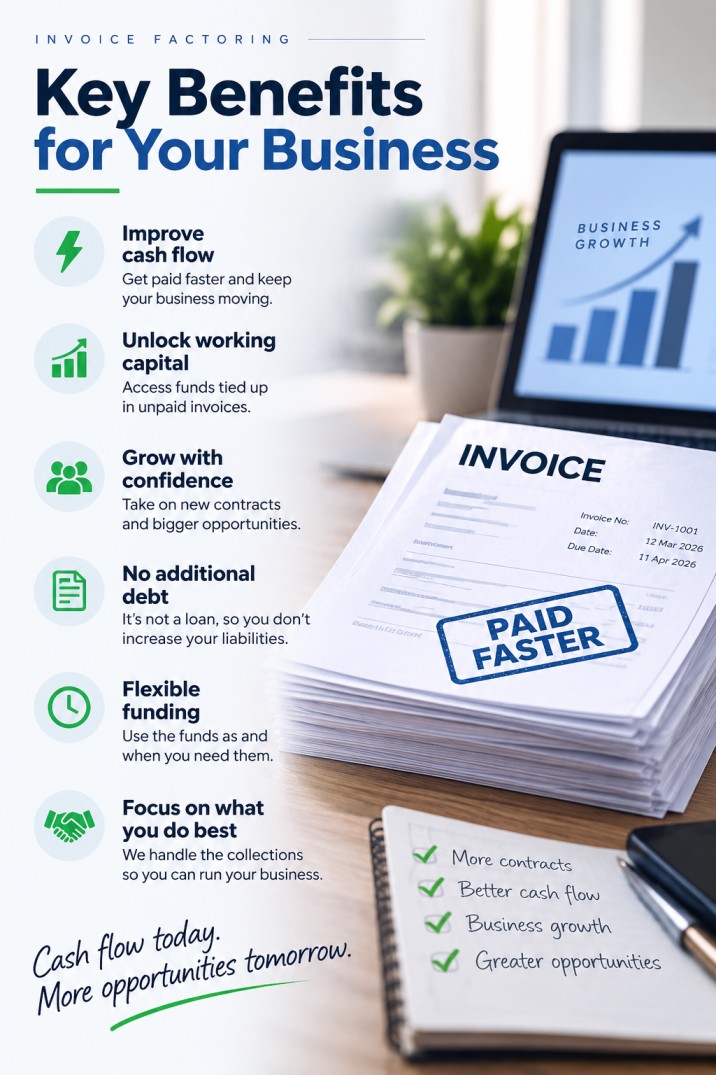
Invoice factoring is designed to help businesses that offer payment terms maintain strong cash flow while continuing to grow.
Although the approval process takes time, it ensures that the facility is structured correctly around your business and your clients.
Once approved, a factoring facility can help your business:
- Unlock cash tied up in invoices
- Improve cash flow
- Take on larger contracts
- Grow without relying on traditional loans
Explore Invoice Factoring for Your Business
If your business offers 30, 60, or 90-day payment terms, invoice factoring may help you access working capital while waiting for your clients to pay.