
Access to funding is one thing.
Using it correctly is what determines whether your business grows or struggles under pressure.
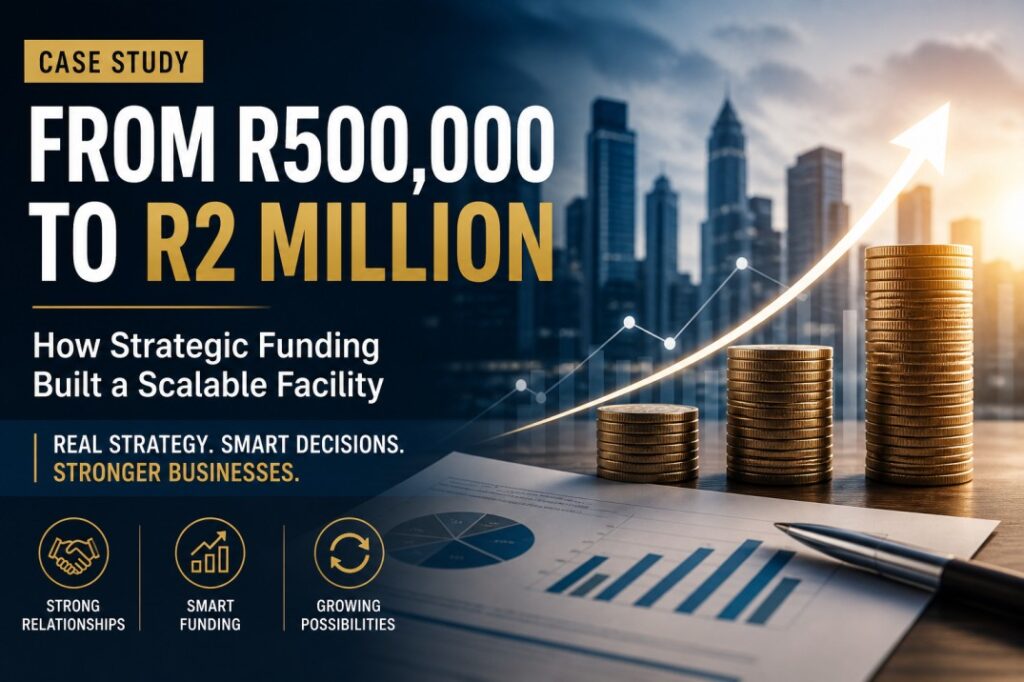
This case study is based on a client who started with a R500,000 unsecured funding facility in 2023 and has since increased their facility to R2 million. To date, they have raised a total of R3,670,000 in capital.
This level of growth didn’t come from applying everywhere or accepting every funding offer available.
It came down to discipline, structure, and making the right decisions from the start.
The Foundation: No Loan Stacking
The most important factor in this client’s success is simple.
They avoided loan stacking completely.
From the beginning, they committed to working with one short-term loan facility and focused on protecting their relationship with that funder. They did not take on multiple loans, and they did not submit multiple applications across different lenders.
This decision alone positioned them for long-term success.
Funders assess more than just affordability. They look at how many facilities a business already has and how often they are applying for funding. A business that is constantly applying or stacking loans is seen as high risk.
By keeping their profile clean, this client was able to unlock additional capital every three months and steadily grow their facility.
Using Funding as a Bridging Tool
Another key factor is how the funding was used.
This client did not treat funding as extra cash. They used it as a bridging facility to manage cash flow between project delivery and client payment.
As soon as payments were received from their clients, they repaid the majority of the funding.
This approach allowed them to:
- Keep interest costs under control
- Maintain access to a revolving facility
- Reuse capital every few months
This is how short-term funding is meant to work, yet many businesses misuse it and limit their ability to access funding again.
A Smarter Funding Structure
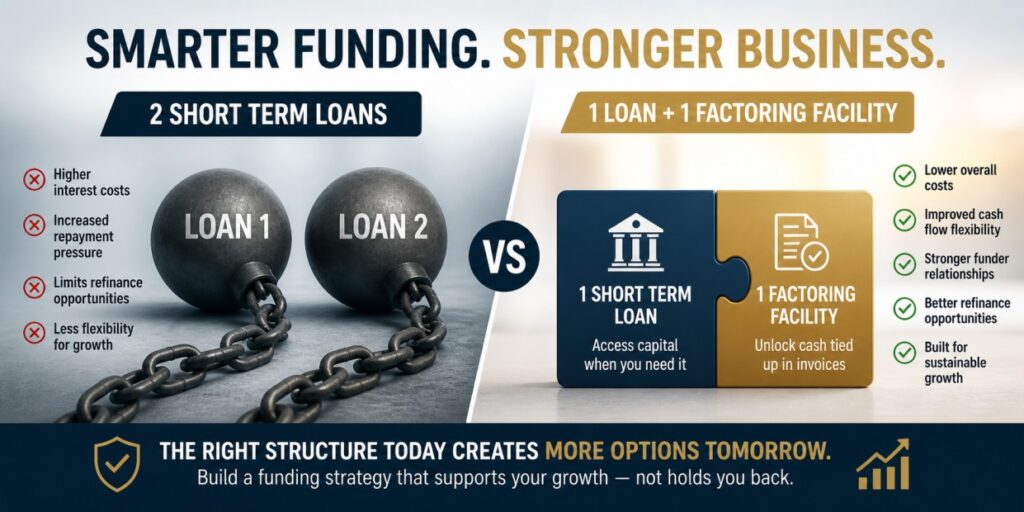
Instead of taking on multiple short-term loans, this client built a more balanced approach.
They combined:
- One short-term loan facility
- One invoice factoring facility
This gave them flexibility in how they accessed capital.
They could use the loan when immediate funding was needed or factor an invoice to unlock cash tied up in their debtors’ book.
This created a more holistic funding strategy and allowed them to access additional capital without overexposing their business to short-term debt or damaging funder relationships.
Understanding How Funders Assess Your Business
One of the biggest mistakes business owners make is taking funding without understanding how funders evaluate applications.
Credit departments look at:
- The number of applications submitted in a short period
- The number of active facilities
- Overall exposure to short-term debt
If a business is taking funding blindly and accepting every offer, it signals poor financial management.
It shows that there is no clear funding strategy in place.
This often results in:
- Reduced access to better funders
- Higher-cost funding options
- Limited ability to increase facility sizes
The Consequences of Loan Stacking
We see this often.
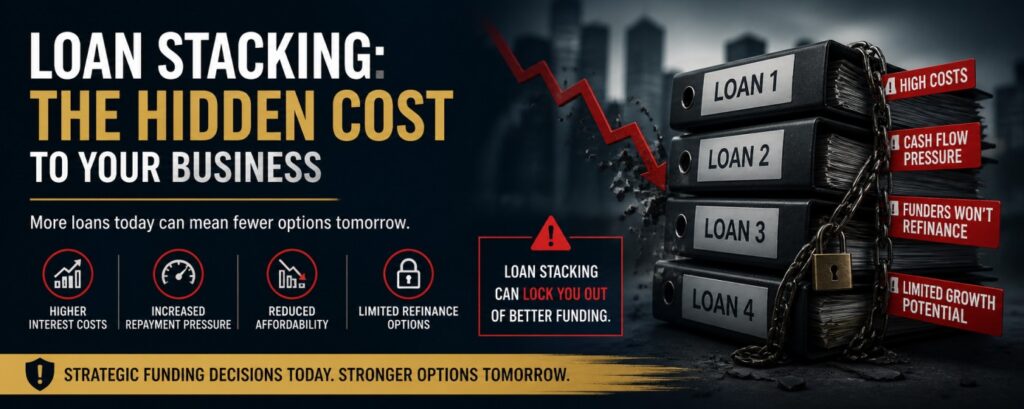
Clients who insist on loan stacking end up damaging relationships with strong funders who do not allow multiple facilities. As a result, they are pushed towards more expensive funders who are willing to take on that level of risk.
Taking on multiple loans increases repayment pressure and the overall cost of funding, which puts strain on cash flow and reduces affordability.
The bigger issue, however, is what happens next.
The moment a business loan stacks, it limits its ability to refinance. Many funders will not take on applications where there are multiple existing facilities, which means the business cannot move into better terms or restructure its funding effectively.
In many cases, this leads to businesses becoming overexposed, falling into arrears, or losing refinance opportunities that could have improved their position.
A Real Example of What Can Go Wrong
I recently worked with a client who chose to take on loan stacking without fully understanding the consequences.
They accepted a project based on the assumption that they would refinance with another funder.
What they didn’t consider was that the funder they intended to refinance with does not accept loan stacking.
The result was costly.
They lost access to a 12-month refinance option at approximately 3% per month. Instead, they were forced to work with a funder offering a 6-month facility at a higher cost of 4.25% per month.
This increased their repayment pressure and reduced their flexibility.
It was a difficult lesson, but it highlights an important point.
Funding decisions made without understanding the full impact can limit your future options.
Why Strategic Guidance Matters
Every funder operates differently.
Each one has its own requirements, risk appetite, and internal rules that are not always publicly shared.
Understanding these differences is what allows businesses to structure funding correctly and position themselves for growth.
When you work with a finance consultant, you gain access to that insight.
It’s not just about securing funding.
It’s about knowing how to use it in a way that strengthens your business over time.
Final Thought
The difference between a R500,000 facility and a R2 million facility is not luck.
It’s structure.
It’s discipline.
And it’s making the right decisions at each stage of your funding journey.
Apply or Review Your Funding Structure
If your business is:
- Waiting on client payments
- Taking on larger projects
- Experiencing cash flow pressure
Then it’s worth reviewing how your funding is structured before making your next move.
You can apply for unsecured business funding here:
https://premierfinance.co.za/unsecured-business-loan/
Or, if you want to understand how to position your business properly, you can set up a call with me.
We’ll go through your current funding, how funders are likely to assess your business, and how to structure your facilities so they support your growth instead of limiting it.
There’s no cost to your business for this.
Because the goal isn’t just to get funding approved.
It’s to make sure it works for you long term.