
How to Secure Purchase Order Finance for Your Business in South Africa

You’ve been awarded a tender or secured a substantial purchase order. It’s a great opportunity for your business, but there’s one problem: you need funding to fulfil the contract.
At Premier Finance, we regularly hear from business owners in this position. They’ve secured the work but don’t have sufficient working capital to purchase materials, pay suppliers or cover the costs of completing the order.
Many assume that a confirmed purchase order from a reputable customer should be enough to secure funding. Unfortunately, they soon discover that many business funders don’t offer purchase order finance.
So why is purchase order funding so difficult to obtain, and how can your business improve its chances of securing it?

What Is Purchase Order Finance?
Purchase order finance is a form of short-term business funding that helps companies cover the costs of fulfilling confirmed customer orders before receiving payment.
For example, your business receives a purchase order worth R2 million but needs R1.2 million upfront to purchase the materials required to complete the contract.
Your customer will only pay once the goods have been delivered and the invoice approved.
Although the transaction may be profitable, you need access to working capital before you can generate the revenue.
Purchase order finance is designed to help bridge this gap. However, securing this type of funding is often more difficult than business owners expect.

Why Is Purchase Order Funding So Difficult to Obtain?
The biggest challenge with purchase order funding is the risk involved.
Whenever a funder advances money, it needs to understand how that money will be recovered if something goes wrong.
With secured business finance, the funder may have an asset it can claim against. With invoice factoring, the funder can obtain rights to payment from an existing invoice for goods or services already delivered.
With purchase order funding, however, the funder is advancing money against work that hasn’t been completed.
Let’s return to the R2 million purchase order.
If a funder advances R1.2 million and your business fails to deliver the goods, the customer who issued the purchase order may have no obligation to pay.
The funder cannot simply present the purchase order and demand payment for goods or services that were never delivered.
This creates a significant financial risk.
Even when a business intends to fulfil its contract, unexpected problems can arise. Suppliers may fail to deliver, projects may be delayed, or additional costs may make the contract financially unviable.
Any delay in completing the work can also delay the funder’s repayment.
In a worst-case scenario, the business could exhaust the funding without completing the project, leaving the funder with limited recovery options.
This is why purchase order finance is considered a specialist funding product rather than a standard business lending solution.
Why a Purchase Order Isn’t Sufficient Security
A purchase order confirms that a customer has agreed to purchase goods or services under specified conditions.
However, it doesn’t necessarily mean the customer is already obligated to pay.
The business must first fulfil its contractual obligations, which may include manufacturing, delivering or installing the goods and obtaining customer acceptance.
Until these requirements have been met, there may be no invoice due for payment.
Even when the purchase order comes from a large corporation or government department, the funder must still consider whether the supplier can successfully complete the transaction.
A financially strong customer doesn’t eliminate the risk of a business failing to deliver.
Why Invoice Factoring Is Different
Understanding the difference between purchase order funding and invoice factoring is important because it explains how businesses may be able to access this type of finance.
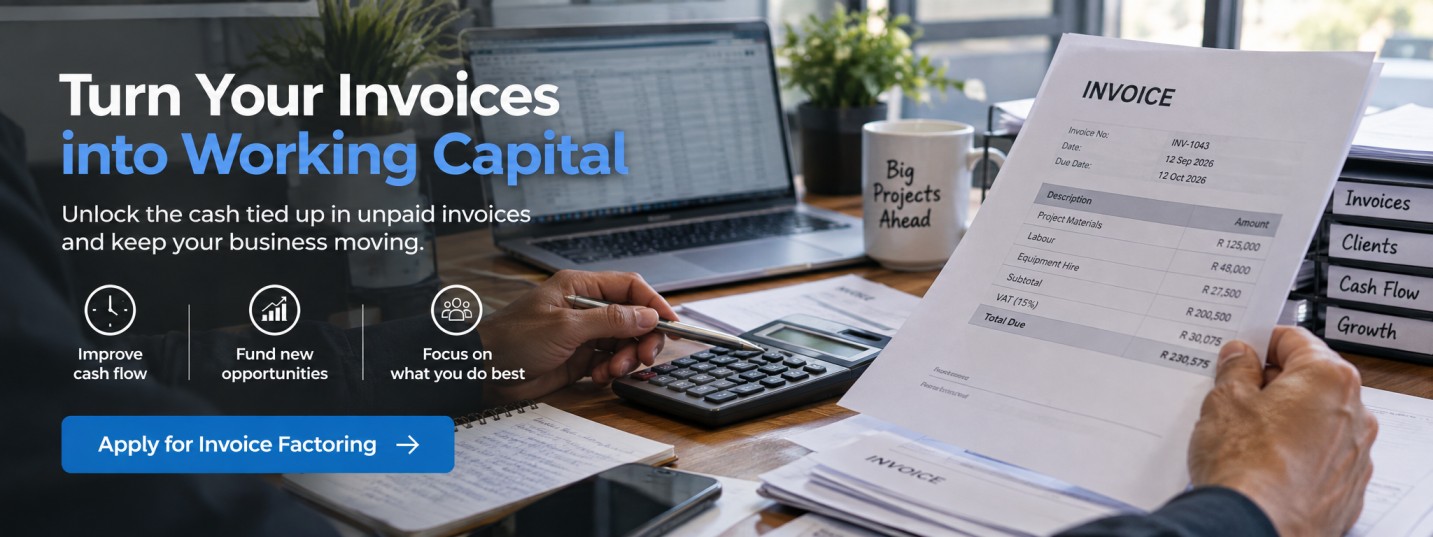
Invoice factoring allows businesses to obtain working capital against qualifying unpaid invoices for goods or services that have already been delivered.
Instead of waiting 30, 60 or 90 days for customers to pay, a business may be able to access up to 80% of an approved invoice’s value upfront.
For example, if your business has delivered R500,000 worth of goods and issued an invoice, a factoring facility could potentially advance R400,000 while you wait for the customer to settle the account.
The difference is that the transaction has already taken place.
The funder can verify the invoice, assess the customer’s payment obligation and obtain rights to the invoice proceeds, depending on the arrangement.
This provides a more clearly defined repayment mechanism than advancing money against a purchase order that hasn’t been fulfilled.
Invoice factoring therefore presents a different risk profile and is generally easier for funders to assess.
How to Secure Purchase Order Funding Through Premier Finance
Fortunately, purchase order funding isn’t impossible to obtain.
Through the Premier Finance funding network, we have access to a funder willing to consider purchase order funding for businesses with an established, actively trading invoice factoring facility.
There is one important requirement: the business must already have an active invoice factoring relationship with this particular funder.
Purchase order finance is not offered as a standalone product to new applicants through this arrangement.
Why?
Because an existing factoring relationship allows the funder to understand how the business operates before taking on the additional risks associated with purchase order funding.
Through regular invoice financing transactions, the funder can assess the company’s trading performance, customer payment history and ability to fulfil its obligations.
Over time, this establishes a level of confidence that doesn’t exist when a business approaches a funder for the first time.
When that business subsequently secures a larger contract requiring upfront funding, the funder already has a trading history to consider.
This makes it possible to assess whether the existing funding relationship can be extended to accommodate qualifying purchase orders.
In other words, purchase order funding may become an extension of an established invoice factoring facility rather than an entirely new funding arrangement.
Each purchase order will still be assessed individually, and approval is not guaranteed.
Why You Should Establish a Funding Relationship Before Winning Your Next Tender
Many businesses only begin searching for purchase order finance after they’ve secured a large contract and urgently need capital.
Unfortunately, that’s often too late to establish the trading relationship required by our participating funder.
If your business regularly supplies goods or services to commercial customers on 30, 60 or 90-day payment terms, an invoice factoring facility may be worth considering.
Not only can factoring help improve cash flow by releasing capital tied up in unpaid invoices, but an established relationship with the right funder may also create opportunities for future purchase order funding.
Instead of approaching an unfamiliar lender when you secure a major contract, you can discuss your requirements with a funder that already understands your business.
This is particularly valuable for businesses planning to expand, tender for larger contracts or take on projects requiring significant upfront expenditure.
The best time to establish a funding relationship is before you need the money.
Explore Your Business Funding Options With Premier Finance
At Premier Finance, we help South African businesses access working capital solutions through our network of funders.
If your business regularly invoices commercial customers on credit terms, we can help you explore whether an invoice factoring facility is suitable for your operations.
For businesses that establish an actively trading facility with our participating funder, purchase order funding may become an option for future qualifying contracts.
If you’re planning to grow your business through larger orders or tenders, consider putting the right funding arrangements in place now.
Frequently Asked Questions About Purchase Order Finance
Can I get purchase order funding for an awarded tender?
Yes. Some specialist funders in South Africa finance qualifying purchase orders and awarded tenders. However, an awarded tender alone doesn’t guarantee approval. Funders assess the business, the customer, the transaction and available repayment protections.
Why do funders decline purchase order finance applications?
Purchase order finance involves advancing money before goods or services have been delivered. If the business fails to complete the contract, the customer may not be obligated to pay, creating a significant recovery risk for the funder.
Does Premier Finance offer purchase order funding?
Premier Finance has access to a funder that may consider purchase order funding for businesses with an established, actively trading invoice factoring facility with that funder. Standalone purchase order finance is not available through this arrangement.
Can I get purchase order finance without collateral?
Some specialist funders may consider purchase order finance without traditional asset collateral, but they generally require alternative risk protections. Requirements vary depending on the funder and transaction.
What is the difference between purchase order finance and invoice factoring?
Purchase order finance helps fund qualifying costs before an order has been fulfilled. Invoice factoring provides working capital against qualifying unpaid invoices after goods or services have been delivered.
Can invoice factoring help me qualify for purchase order funding?
Potentially. An established invoice factoring relationship gives a funder insight into your trading performance and customer payment history. Through Premier Finance’s participating funder, this relationship is required before purchase order funding can be considered.
What if my business doesn't qualify for purchase order finance?
Depending on your business’s financial position, other working capital solutions may be available, including unsecured business loans, secured business finance or invoice factoring. Premier Finance can help assess which options may be suitable.